


It’s Green and It Eats Ants. A Woodpecker?
The European Green Woodpecker rarely drums, but it laughs loudly.
Its unmistakable call usually gives it away long before you see it. About 30 cm long, these medium-sized birds move nimbly across trunks, climbing effortlessly, and flying in a rolling pattern: a few wingbeats followed by a short glide to the next tree — or straight down to the ground.
Because that’s where they hunt.
For ants.
Unlike other woodpeckers, the Green Woodpecker has a relatively weak bill, not suited for chiseling deep into wood. Instead, it comes equipped with a remarkable weapon: a 10 cm long sticky tongue covered with barbed hooks, perfect for catching ants and larvae in grasslands.
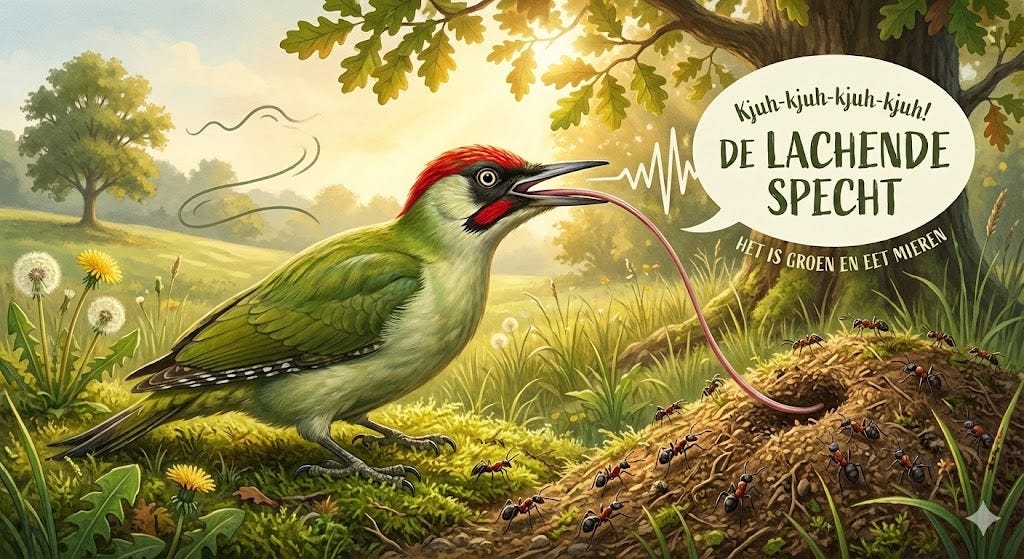
You can recognise them easily: a beautiful green back, a bright red crown, and a black mask around the eye. Males also have a red “moustache stripe” under the eye — females have a black one. Their grey, dagger-like bill is strong enough to dig into soil and anthills, but unfortunately not strong enough to carve out a proper nest cavity. That’s why Green Woodpeckers must rely on abandoned nest holes from other woodpecker species — or hope to stumble upon a nicely decaying tree they can work their way into.
This might raise the question: is the Green Woodpecker really a woodpecker at all?
Yes — absolutely.
They are true tree-climbers, equipped with the classic woodpecker foot design: two toes pointing forward and two pointing backward. Combined with stiff tail feathers, this gives them incredible grip on bark. But when it comes to getting food, it’s all about that long, barbed, sticky tongue.
The population has been slowly increasing again in recent years, now reaching about 11,000 breeding pairs in the Netherlands. As a resident species, we can enjoy them year-round.
Less enjoyable, perhaps, for the ants.
How to Tell Our Woodpeckers Apart
1) Great Spotted Woodpecker
Our most common woodpecker. Smaller than the Green Woodpecker (around 25 cm). Black-and-white plumage, red underbelly, and males have a red spot on the nape. Famous drummers and tireless chiselers.
2) Middle Spotted Woodpecker
A bit smaller. Both sexes show a red patch on the crown. Weak drummers, usually found high in the trees. Around 2,000 breeding pairs, mostly in eastern Netherlands.
3) Lesser Spotted Woodpecker
Even smaller (15 cm). Males have a red crown, but otherwise this species is entirely black-and-white. Behaviour similar to the Great Spotted Woodpecker. Population is roughly half the size of the Green Woodpecker.
4) Black Woodpecker
The largest woodpecker in our country (about 50 cm). Entirely black with a bold red cap. Loud drumming, striking calls. Around 1,500 breeding pairs, mainly in wooded areas such as the Veluwe.
5) Wryneck
A small (16 cm) brownish woodpecker species. Winters in Africa. About 200 breeding pairs in the Netherlands, mostly in Friesland and the Veluwe.
Finally, the Grey-headed Woodpecker, which resembles the Green Woodpecker but is slightly smaller and greyer, is only seen here as a rare vagrant.
🎙️ Listen to the full Dutch episode on mennoenerwin.nl — your monthly guide to nature, science, and wonder.
We now have three publications:
Dutch podcast on wednesday
Nieuwsbrief NL → dutch newsletter
Newsletter ENG → same newsletter but in english
You can change what you will receive in your substack email from us in the bottom manage subscription or go to the link https://menno-en-erwin.substack.com/manage-subscription
Blijf op de hoogte!
Wil je meer weten over de geheimen achter ons drinkwater en andere fascinerende natuur- en wetenschapsonderwerpen? Abonneer je dan op onze podcast en Substack via mennoenerwin.nl, en mis geen aflevering meer. Direct naar de podcast ? Klik hier
je kan je subscripties wijzigen zodat je alleen de engelse of nederlandse newsbrief ontvangt hier https://menno-en-erwin.substack.com/manage-subscription
